In El Salvador we go along with our daily lives and then are out of the blue sometimes hit with the reality of the violence that happens here or has happened here. Today while going through SHARE files, I came across a piece written about the 4 American Churchwomen who were killed and started to read it. At one point I stopped reading and realized that I was crying, I guess there are somethings that you can never be immune to, even after living here for a year and a half.
Shortly after I came across this Romero quote and decided to post it. The priest he mentions Alfonso Navarro was killed by paramilitary troops on May 11, 1977, about 1 week and twenty two years ago. He was one of many church leaders and community workers who were brutally assissinated during that time in El Salvador's history. I was most hit by the very last line. Here is it is:
"Who knows if the one whose hands are bloodied with Father
Grande's murder, or the one who shot Father Navarro, if those who
have killed, who have tortured, who have done so much evil, are
listening to me? Listen, there in your criminal hideout, perhaps
already repentant, you too are called to forgiveness."
December 18, 1977
Wednesday, May 20, 2009

Monday, December 15, 2008
December in El Salvador
I just posted a reflection about the church women and I mentioned a movie called "Roses in December," there is one part in the movie when Jean Donovan talks about the beauty of El Salvador and says "where else would you find roses blooming in December?" I hadn't paid too much attention to this quote until now when I am spending December in El Salvador and have discovered the same thing that she did which is: December is one of the most beautiful months in El Salvador.
December in Cincinnati can be a pretty depressing month because the winter season officially kicks in and you know that you will be really cold until about March. This is either helped or aggravated (sometimes both) by the overwhelming season of Christmas. While I can get a little sick to my stomach from too much Christmas cookies, music and mall shopping, there can be something calming and peaceful about a room lit only by Christmas lights and a fire as Carol of the Bells plays softly in the background and snow falls outside. That is not what Christmas decorations are like in El Salvador. They are usually very tacky and out of place, and (in my opinion) completely drowned out by the beautifully blossoming flowers and bright blue skies.
El Salvador December days can turn hot but not too hot and the nights are breezy. The rainy season is over but things haven't dried up completely yet. As you walk through the streets or drive through the countryside, you see brilliant flowers that are colored bright red, magenta, yellow, orange and white. So, today I actually walked through the streets in my neighborhood with my camera to document some of December's finest blossoms. Here are some of my favorites:
 The neighborhood around my El Salvador home
 This is the bus I take to work (the yellow flowers are my favorites)
 There are flowers everywhere you look
 A house by where I work
And to show that I also can appreciate the beauty of December in Ohio, here is one more:
 My home in Ohio
December in Cincinnati can be a pretty depressing month because the winter season officially kicks in and you know that you will be really cold until about March. This is either helped or aggravated (sometimes both) by the overwhelming season of Christmas. While I can get a little sick to my stomach from too much Christmas cookies, music and mall shopping, there can be something calming and peaceful about a room lit only by Christmas lights and a fire as Carol of the Bells plays softly in the background and snow falls outside. That is not what Christmas decorations are like in El Salvador. They are usually very tacky and out of place, and (in my opinion) completely drowned out by the beautifully blossoming flowers and bright blue skies.
El Salvador December days can turn hot but not too hot and the nights are breezy. The rainy season is over but things haven't dried up completely yet. As you walk through the streets or drive through the countryside, you see brilliant flowers that are colored bright red, magenta, yellow, orange and white. So, today I actually walked through the streets in my neighborhood with my camera to document some of December's finest blossoms. Here are some of my favorites:
 The neighborhood around my El Salvador home
 This is the bus I take to work (the yellow flowers are my favorites)
 There are flowers everywhere you look
 A house by where I work
 My home in Ohio
Sunday, December 14, 2008
Remembering the Churchwomen
While I was at home, I watched the movie "Roses in December" with my mom. The movie tells the story of Jean Donovan, a Catholic lay missioner who was murdered along with three nuns by the Salvadoran army on December 2, 1980. I had seen the movie before when I was a student at the Casa but that was almost four years ago. The movie was made just a few years after the women were murdered so it is very dated but it was really good to watch it with my mom because it does a good job of putting the story into the context of the war. We watched it on December 1st which was the day before the anniversary of their death. I found a reflection written by a Sister on a delegation to El Salvador with the SHARE foundation and I want to share a part of it
"It was 23 years ago today that four churchwomen were found in a shallow grave in a farmer’s field, some raped, all dead-- each with a single bullet to their head.
The description of such violence was not at all uncommon in 1980 in El Salvador- a countryside desecrated by civil war, a people not at all defeated by the horrors they lived daily. A resurrection people, fed by the blood of the martyrs and the bread of daily struggle for a better life created the peace filled scene I witnessed today--a lovely pasture populated with a smart brick chapel, a beautiful white stone monument complete with a memorial plaque and a tree that is planted in the center of an area outlined with small white rocks. A lovely space- now filled with local folks and their living memory of war and peace accords; Latin American religious sisters revisiting the core of their passion, commitment and witness; and people from the North – standing in solidarity.
Aiding and abetting the enemy, the ‘subversive acts’ of the nuns and one lay missioner were caring for victims of war and war- orphaned children. Addressing the social, political and economic disparity between the rich and the poor, teaching methods of self-empowerment, and community development were direct threats to the power structure of the ruling class. In those times threats were eliminated. "
As I read the reflection and as I watched the movie, I found myself tearing up at the images of the women´s bodies being pulled out of ditches, of people getting shot at while attending Archbishop Romero´s funeral mass, and of the children in the refugee camps. Sometimes I forget the horrorific history of this country during the civil war. This makes sense as I work with young people who were mostly born at the end of or after the war. But that does not mean that they are unaffected. A culture, a country, takes years and years to recover from such trauma.
As with the Jesuit vigil, I am reminded as to why I, a north american women, am in El Salvador. Jean Donovan gave up a very comfortable life in the states to work with refugees in El Salvador. I remember how inspired I was by this the first time that I heard of her. A woman who was inspired to walk alongside people who were being persecuted and ignored by the rest of the world. Granted, my life in El Salvador is very different than that of those lay missioners who came in the eighties. While still violent, El Salvador is not at war, and I don´t fear for my life much more than I did living in St. Louis (which is a little but not too much). But it is still good to remember who inspired me to be here, and that is all women and men from all over who gave up something comfortable and easy to fight for something that they believed was right. I will close with a quote from Ita Ford, one of the four women who was killed:
"I hope you come to find that which gives life a deep meaning for you. Something worth living for - maybe even worth dying for, something that energizes you, enthuses you, enables you to keep moving ahead."

Saturday, December 13, 2008
The UCA Vigil
Every year on November 15th, the University of Central America (UCA) celebrates the anniversary of the death of six Jesuits and two women who were killed on its grounds in 1989.
They were:
Ignacio Ellacuria
Amando Lopez
Ignacio Martin Baro
Juan Moreno
Segundo Montes
Joaquin Lopez y Lopez
Elba Ramos
Celina Ramos

Here is a brief description of what happened:
The Vigil is really incredible. During the day people spend hours hunched over the walkway of the UCA creating beautiful "alfombras" or sand art. Designs relating to their group and or the memory of the Jesuits. Then at six at night, when all of the alfombras are finished, there is a candle lighting ceremony in which every person at the vigil (which were a lot) recieved a candle to carry through the procession and than lit the candle of the lights of others. At around six thirty the procession begun in which the crowd formed left the University gates and walked the distance to the other entrance where they then walked over the beautiful alfombras that had been created for just this. It was a very moving experience to see so many people honoring the memory of those who gave their life for what they believed in. Here is the picture I took of the procession:

After the procession their was a very big mass which was followed by all night festivities. A number of artisans were selling their crafts and a number of UCA groups were selling food. People had come from all over El Salvador and all over the world to be here the entire night. Different music groups played a mix of traditional folk music and newer "world music." I am told that the festivities go on until six in the morning when the sun comes out and the busses are running again. I left at 12:30 so I didn't stay to find out. I was so glad I went though, these type of events remind me as to why I am in El Salvador and thats good to do every once in a while.
They were:
Ignacio Ellacuria
Amando Lopez
Ignacio Martin Baro
Juan Moreno
Segundo Montes
Joaquin Lopez y Lopez
Elba Ramos
Celina Ramos
Here is a brief description of what happened:
"On November 16, 1989, six Jesuit priests - Ignacio Ellacuria, Segundo Montes, Ignacio Martin-Baro, Joaquin Lopez y Lopez, Juan Ramon Moreno, and Amado Lopez - were murdered by the Salvadoran military on the campus of the University of Central America (UCA) in San Salvador, El Salvador. Their housekeeper, Elba Ramos, and her daughter Celia Marisela Ramos, were murdered there as well. The Jesuits were labeled subversives by the Salvadoran Government for speaking out against the oppressive socioeconomic structure of Salvadoran society. Their assassinations were ordered for their unwavering defense of the poor.
The Jesuits were six of over 70,000 victims who died in El Salvador’s civil war which raged in the 1980’s and early 1990’s. The vast majority of these victims were civilians killed by El Salvador’s armed forces and paramilitary death squads. The death of the Jesuits brought international outrage and condemnation upon the Salvadoran Government and pressured them to negotiate an end to their country’s civil war."
-http://www.spc.edu/pages/1814.aspThe Vigil is really incredible. During the day people spend hours hunched over the walkway of the UCA creating beautiful "alfombras" or sand art. Designs relating to their group and or the memory of the Jesuits. Then at six at night, when all of the alfombras are finished, there is a candle lighting ceremony in which every person at the vigil (which were a lot) recieved a candle to carry through the procession and than lit the candle of the lights of others. At around six thirty the procession begun in which the crowd formed left the University gates and walked the distance to the other entrance where they then walked over the beautiful alfombras that had been created for just this. It was a very moving experience to see so many people honoring the memory of those who gave their life for what they believed in. Here is the picture I took of the procession:

After the procession their was a very big mass which was followed by all night festivities. A number of artisans were selling their crafts and a number of UCA groups were selling food. People had come from all over El Salvador and all over the world to be here the entire night. Different music groups played a mix of traditional folk music and newer "world music." I am told that the festivities go on until six in the morning when the sun comes out and the busses are running again. I left at 12:30 so I didn't stay to find out. I was so glad I went though, these type of events remind me as to why I am in El Salvador and thats good to do every once in a while.
Thursday, November 13, 2008
Cristiani and others charged with war crimes for the death of the UCA Jesuits
Former El Salvador leader in war crimes case
- Story Highlights
- Case involves killing of 6 Jesuit priests, their housekeeper and her daughter
- 14 former Salvadoran military officers also accused of war crimes
- Most of the slain Jesuits were born in Spain
- One of the most notorious episodes of El Salvador's 12-year civil war
By Al Goodman CNN Madrid Bureau Chief
MADRID, Spain (CNN) -- Human rights groups from the United States and Spain filed a lawsuit in a Spanish court Thursday, charging El Salvador's former president, Alfredo Cristiani, with covering up crimes against humanity.
The case involves the killing of six Jesuit priests, their housekeeper and her teenaged daughter nearly two decades ago during El Salvador's civil war.
In addition, 14 former Salvadoran military officers are accused of war crimes, murders and state terrorism in connection with the massacre dating back to November 1989.
Most of the slain Jesuits were born in Spain. They were killed at their residence at the prestigious Central American University, in El Salvador's capital, San Salvador. Reports at the time said they were tortured and then shot.
It has become one of the most notorious episodes of El Salvador's 12-year civil war that pitted leftist guerrillas against the U.S.-backed conservative government. Some 75,000 people died.
The case filed by two human rights groups in Madrid argues that justice was never done in El Salvador. Two military officers were convicted of murder in 1991 in the deaths of the Jesuits, but were pardoned in 1993 under an amnesty law approved by the national assembly.
The case was taken to Spain's National Court, because of its involvement in other high-profile human rights cases.
The same Spanish court issued an arrest warrant for former Chilean dictator Augusto Pinochet in 1998, while he was in a London hospital. For the rest of his life he fought legal battles -- first in England and later in Chile -- to avoid convictions.
The Spanish court has also taken on human rights cases from other countries, including Argentina and Guatemala, testing a relatively new international legal principle known as Universal Jurisdiction.
It contends that if justice for human rights abuses is not served in the country where the crime occurred, then a court in another country can intervene.
The groups filing suits are the San Francisco-based Center for Justice and Accountability and the Spanish Association for Human Rights.
Family members from at least two of the slain Jesuits will join the lawsuit later, the groups said.
It could take the National Court weeks or even months to determine if it will accept the case.
Spain and El Salvador have an extradition treaty. But a lawyer for the Center for Justice and Accountability told CNN that the most immediate practical effect of the case might be an effective ban on Cristiani and the 14 former officers from leaving El Salvador, for fear of arrest.
If they were ever tried before a Spanish court and convicted on the charges, they could serve up to 30 years in prison.
In an interview with CNN a few months before he was killed, university rector Ignacio Ellecuria praised then-president Cristiani, whom the human rights groups now accuse of covering up the crime.
"We have to recognize that Cristiani is a man of his word, who keeps his promises," Ellecuria told CNN. "Personally I consider Cristiani an ethical, responsible person who will not offer to do what he can't or doesn't wish to do."
Ignacio Martin-Baro, another slain Jesuit, spoke at the time about the chilling effect of the long-running Salvadoran civil war.
"We have become used to violence," Martin-Baro said. "We have become used to living in a very dangerous world. We have learned to live, accepting death, extraordinary abnormal death into our lives."
For years, the extreme right in El Salvador had accused the Jesuits of siding with the leftist guerrillas, according to a CNN report shortly after the killings.
Uniformed troops were seen searching the living quarters of the priests at Central American University two days before they were killed, CNN reported.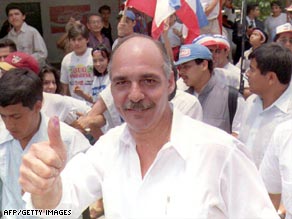
Alfredo Cristiani in 1994 shortly after he voted during the country's second round presidential runoff.
Monday, October 27, 2008
The Gender and Sexuality Workshop
Part of the work that we do at CFO is planning workshops around important issues for youth like human rights, nonviolent communication, self-esteem, leadership, sexuality, etc. Some of these topics interest the youth we work with more than others. Nonviolent communication, for example, seems to be a pretty hard concept for a lot of them to grasp, understandably so as these communities have a very violent history which has shaped the way people live and interact. Sexuality, however, seems to be one of the most popular themes and once the kids get past the initial embarrassment, they REALLY want to talk about it. Which is good, because not many other people are really talking about it with them. According to the kids that I have talked to, public health workers come into the schools about once a year and give a quick overview of basic sexual health. At home, it is often not talked about. But this lack of atention to something that is so much on the minds of teenagers is a big problem in a country where 1/3 of babies are born to teenage mothers and the number of new HIV cases is rising every year.
In talking about sexuality there are a lot of myths and taboos to break down, and not surprisingly, a lot of them relate to women. For that reason, gender workshops for men and for women have become very needed. In one community where we work, Community Raul Rivas Vasquez, all of last year was dedicated to learning about sexuality. This year, in trying to continue some with the theme, we have started a girls group to meet seperately from the guys and to have a space to talk about gender, among other things, in a space that is safe. About a month ago, we did a half day workshop on gender and then went on a field trip in the afternoon to Los Planes de Renderos, a famous scenic lookout about the city. We took twenty-girls as well as three kids who are children of the partipants, two little sisters who were being babysat and couldn't be left alone, a woman from the community who helped us organize the group, her grandson. It was quite an adventure.
The workshop agenda was to briefly touch on sexuality basics and then look at the gender roles in Salvadoran society. It was really interesting to listen to what they thought and ways they all thought alike and the things the disagreed on. The girls have a ton of energy which made the activites fun, though sometimes a little hard to get under control. Overall though, it went really well. Here are some of my observations about the day
1) Almost all of the girls felt that they were trapped in their homes to run the house while their parents worked while their brothers were free to roam the streets and live as they pleased
2) The situation for women in El Salvador, though still very poor, has changed a good deal in the past few decades, so for these girls some of the gender rules do not feel as strong as it does for older Salvadoran women
3) Though all from the same community, a few girls have higher levels of education (they have been able to attend high school or the university, something that is not very common for young people in their community). The ones with higher level of education were more critical of objectification of women.
4) Most of the girls (including the three mothers in the group) did not see men as reliable when it comes to helping support a family
I feel as if I am constantly learning more and more about Salvadoran society through what I see everyday. This workshop was fascinating for me and I really hope that the girls took something from it as well. The field trip to Los Planes was a lot of fun, despite some slight rain and the fact that we had to cram ourselves into a pickup to get there. We took a ton of pictures and you can check them out on my facebook account. Just click on the link below. The second half of the pictures are of a mural that we did in the same community a few days later.
Click to see pictures!!!
Hope you enjoy!
 pic of some of the girls from the lookout at El Puerto del Diablo (the Devil's Door), the lookout point in Los Planes de Renderos
Wednesday, October 22, 2008
Food in El Salvador
About two months ago I got inspired by my brother's Argentina blog and decided I was going to write a blog about food in El Salvador. This is me actually getting around to doing that.
So here it goes... food in El Salvador. There are somethings about the food here that I absolutely loved from the start, then there are some things that took me awhile to come around too. There are also those things about Salvadoran food that I really don't like. Seeing as I can't possibly touch on all of it, I will try to hit the highlights.
Comida Tipica
This is the term you to describe typical Salvadoran plates, or the food that Salvadorans most often eat, which would be: rice and beans, Salvadoran tortillas (made from corn, smaller and a lot thicker than Mexican tortillas), sour cream, avocado, Salvadoran cheese (fresco which is softer or duro which is harder, both VERY salty), fried or boiled plantains, scrambled eggs with vegetables and of course COFFEE!!! A few comments: 1) the coffee is served with a ton of sugar and everyone including children drink it, usually its very weak 2) it has taken me a really long time to be able to get used to the sour cream and cheese 3) when the rice and beans are mixed they are called casamiento which means marriage. Everything is seasoned with salt and lime.
Fruit
I've already written a whole blog entry about fruit in El Salvador so I won't elaborate too much, but its definitely one of my favorite things about the food here. Mangoes, oranges, jocotes, mamays, anonas, zapote, mamones, papaya, pineapple, coconut, arrayan, bananas, etc. The can all be bought from street vendors and in markets like the Mercado Zacamil close to my apartment. On street corners and family run cafeterias all of the city you can buy smoothies, called licuados which is any of these fruits mixed with milk, orange juice or carrot juice. It's one of my favorite things for breakfast. Another favorite fruity treat is natural ice cream that is sold mainly by men pushing carts through neighborhoods and parks.
Vegetables
This is mostly the same, but some special veggies found here are pipian-probably one of my favorite vegetables ever which is kind of like zuchinni and squash but sweeter. There is also guisquil, a big watery squash; ayote, another famous squash; and lorocco, which are tiny buds that grow on a vine. People also eat the national flower which is called Flor de Izote.
Pan Dulce (Sweet Bread)
Small bakeries can be found pretty much every couple of blocks in San Salvador though the quality of the bread sold at them differs greatly. For example the bakery closest to my house is not that great while the bakery by the Participacion Juvenil office is one of the best bakery's I've been too. At the bakery you can buy pan dulce which includes donuts, semita, maria luisa, empanadas, etc, etc. All different types of sweet bread that are oftened flavored with icing and filled with creme or pineapple jelly. My favorite and one of the more famous of Salvadoran pan dulce is quesadilla, which is NOT like a Mexican quesadilla. It's like a sweet cornbread that is made with cheese, its delicious.
Pupusas
This is its own category because its the most famous Salvadoran food. For those who don't know, a pupusa is a Salvadoran tortilla, which like I said is thicker and made with ground corn, that is stuffed usually with beans and cheese, porkrind and cheese, lorocco with cheese, cheese alone or my preference, beans alone. It is served with a watery tomato salsa and curtido which is like pickled cabbage and carrott relish. Pupusas are eaten primarily for breakfast or dinner and are EVERYWHERE is El Salvador. There is a pupuseria next too my house which we like to hit up at least once a week.

Maiz (Corn)
I am including this as a category because a large number of Salvadoran typical foods are made from corn. They say that corn was holy to the indigenous that lived around here and that it is understable why when you see how much food can come from it. I already mentioned pupusas and tortillas, but those are not the only things. Tamales are another popular food which is salty, soft, corn dough filled with veggies or chicken and cooked inside a corn stalk leaf rolled up. Tamales are also served sweetened instead of salty and fried. Atol is a thick creamy drink that is made from corn but is sweetened almost like pudding. Shuco is a salty thick drink made from blue corn and served with hot sauce and beans and eaten by dipping bread in it. Corn is also served toasted with lime and salt or as elote loco which is cooked corn on a stick slathered in ketchup, mustard, mayonaise, holaindaise sauce and sprinkled in cheese. I enjoy all of these foods except the last one which I think is disgusting.
Drinks that I have not mentioned
One type of drink I like is fresco which is juice that is usually served at lunch time and made by mixing fresh fruit juice, water, sugar and ice. Flavors include: Flor de Jamaica (made from a flower petal and also served as tea), tamarindo, arrayan, orange and pineapple. Horchata is also served at lunch time, this is sweetened rice milk. As for hot drinks, besides coffee, which is drinken by everyone at anytime regardless of age or temperature, the main other hot drink is chocolate, which is Mexican chocolate melted and mixed with hot water. I really like it a lot, though some people really don't (my friend dropped her camera down an outhouse toilet while trying to covertly dump out the chocolate that was given to her at an event).
Other highlights
Pasteles: veggies or meat cooked into fried dough and served with curtido (see pupusas)
Arroz con leche: hot rice with milk, cinnamon and sugar
Coconut milk: most often drinken by chopping off the top of a coconut and sticking a straw in it
Empanadas: stuffed pastry with veggies or meat
chocofruta: bananas, strawberries, pineapple or grapes on a stick dipped in chocolate
Poleada: vanilla custard
Churros españoles: fried dough covered in sugar and served at fairs (like funnel cake)
Dulces: coconut or tamarindo concentrate sweetened and served at fairs
Things I think don't like about Salvadoran food:
Sopa de pata: which is cow foot soup
Tortas: fried sandwiches with ham and massive amounts of mayo and ketchup
Lack of good salad (salad is lettuce with one tomato and salt on top)
The amount of oil used in everything
The fact that at lunch time EVERYTHING has meat in it
How often hot dogs are cut up and thrown in with pasta, eggs or beans
Those are my highlights and lowlights of Salvadoran food. There are other things that are okay that I have not covered but maybe for the next food blog. I hope anyone reading feels like they learned a little about food in El Salvador!
So here it goes... food in El Salvador. There are somethings about the food here that I absolutely loved from the start, then there are some things that took me awhile to come around too. There are also those things about Salvadoran food that I really don't like. Seeing as I can't possibly touch on all of it, I will try to hit the highlights.
Comida Tipica
This is the term you to describe typical Salvadoran plates, or the food that Salvadorans most often eat, which would be: rice and beans, Salvadoran tortillas (made from corn, smaller and a lot thicker than Mexican tortillas), sour cream, avocado, Salvadoran cheese (fresco which is softer or duro which is harder, both VERY salty), fried or boiled plantains, scrambled eggs with vegetables and of course COFFEE!!! A few comments: 1) the coffee is served with a ton of sugar and everyone including children drink it, usually its very weak 2) it has taken me a really long time to be able to get used to the sour cream and cheese 3) when the rice and beans are mixed they are called casamiento which means marriage. Everything is seasoned with salt and lime.
Fruit
I've already written a whole blog entry about fruit in El Salvador so I won't elaborate too much, but its definitely one of my favorite things about the food here. Mangoes, oranges, jocotes, mamays, anonas, zapote, mamones, papaya, pineapple, coconut, arrayan, bananas, etc. The can all be bought from street vendors and in markets like the Mercado Zacamil close to my apartment. On street corners and family run cafeterias all of the city you can buy smoothies, called licuados which is any of these fruits mixed with milk, orange juice or carrot juice. It's one of my favorite things for breakfast. Another favorite fruity treat is natural ice cream that is sold mainly by men pushing carts through neighborhoods and parks.
 Jocotes
Vegetables
This is mostly the same, but some special veggies found here are pipian-probably one of my favorite vegetables ever which is kind of like zuchinni and squash but sweeter. There is also guisquil, a big watery squash; ayote, another famous squash; and lorocco, which are tiny buds that grow on a vine. People also eat the national flower which is called Flor de Izote.
Pan Dulce (Sweet Bread)
Small bakeries can be found pretty much every couple of blocks in San Salvador though the quality of the bread sold at them differs greatly. For example the bakery closest to my house is not that great while the bakery by the Participacion Juvenil office is one of the best bakery's I've been too. At the bakery you can buy pan dulce which includes donuts, semita, maria luisa, empanadas, etc, etc. All different types of sweet bread that are oftened flavored with icing and filled with creme or pineapple jelly. My favorite and one of the more famous of Salvadoran pan dulce is quesadilla, which is NOT like a Mexican quesadilla. It's like a sweet cornbread that is made with cheese, its delicious.
Pupusas
This is its own category because its the most famous Salvadoran food. For those who don't know, a pupusa is a Salvadoran tortilla, which like I said is thicker and made with ground corn, that is stuffed usually with beans and cheese, porkrind and cheese, lorocco with cheese, cheese alone or my preference, beans alone. It is served with a watery tomato salsa and curtido which is like pickled cabbage and carrott relish. Pupusas are eaten primarily for breakfast or dinner and are EVERYWHERE is El Salvador. There is a pupuseria next too my house which we like to hit up at least once a week.
Maiz (Corn)
I am including this as a category because a large number of Salvadoran typical foods are made from corn. They say that corn was holy to the indigenous that lived around here and that it is understable why when you see how much food can come from it. I already mentioned pupusas and tortillas, but those are not the only things. Tamales are another popular food which is salty, soft, corn dough filled with veggies or chicken and cooked inside a corn stalk leaf rolled up. Tamales are also served sweetened instead of salty and fried. Atol is a thick creamy drink that is made from corn but is sweetened almost like pudding. Shuco is a salty thick drink made from blue corn and served with hot sauce and beans and eaten by dipping bread in it. Corn is also served toasted with lime and salt or as elote loco which is cooked corn on a stick slathered in ketchup, mustard, mayonaise, holaindaise sauce and sprinkled in cheese. I enjoy all of these foods except the last one which I think is disgusting.
Drinks that I have not mentioned
One type of drink I like is fresco which is juice that is usually served at lunch time and made by mixing fresh fruit juice, water, sugar and ice. Flavors include: Flor de Jamaica (made from a flower petal and also served as tea), tamarindo, arrayan, orange and pineapple. Horchata is also served at lunch time, this is sweetened rice milk. As for hot drinks, besides coffee, which is drinken by everyone at anytime regardless of age or temperature, the main other hot drink is chocolate, which is Mexican chocolate melted and mixed with hot water. I really like it a lot, though some people really don't (my friend dropped her camera down an outhouse toilet while trying to covertly dump out the chocolate that was given to her at an event).
Other highlights
Pasteles: veggies or meat cooked into fried dough and served with curtido (see pupusas)
Arroz con leche: hot rice with milk, cinnamon and sugar
Coconut milk: most often drinken by chopping off the top of a coconut and sticking a straw in it
Empanadas: stuffed pastry with veggies or meat
chocofruta: bananas, strawberries, pineapple or grapes on a stick dipped in chocolate
Poleada: vanilla custard
Churros españoles: fried dough covered in sugar and served at fairs (like funnel cake)
Dulces: coconut or tamarindo concentrate sweetened and served at fairs
Things I think don't like about Salvadoran food:
Sopa de pata: which is cow foot soup
Tortas: fried sandwiches with ham and massive amounts of mayo and ketchup
Lack of good salad (salad is lettuce with one tomato and salt on top)
The amount of oil used in everything
The fact that at lunch time EVERYTHING has meat in it
How often hot dogs are cut up and thrown in with pasta, eggs or beans
Those are my highlights and lowlights of Salvadoran food. There are other things that are okay that I have not covered but maybe for the next food blog. I hope anyone reading feels like they learned a little about food in El Salvador!
Subscribe to:
Posts (Atom)