Monday, December 15, 2008

December in El Salvador

I just posted a reflection about the church women and I mentioned a movie called "Roses in December," there is one part in the movie when Jean Donovan talks about the beauty of El Salvador and says "where else would you find roses blooming in December?" I hadn't paid too much attention to this quote until now when I am spending December in El Salvador and have discovered the same thing that she did which is: December is one of the most beautiful months in El Salvador.

December in Cincinnati can be a pretty depressing month because the winter season officially kicks in and you know that you will be really cold until about March. This is either helped or aggravated (sometimes both) by the overwhelming season of Christmas. While I can get a little sick to my stomach from too much Christmas cookies, music and mall shopping, there can be something calming and peaceful about a room lit only by Christmas lights and a fire as Carol of the Bells plays softly in the background and snow falls outside. That is not what Christmas decorations are like in El Salvador. They are usually very tacky and out of place, and (in my opinion) completely drowned out by the beautifully blossoming flowers and bright blue skies.

El Salvador December days can turn hot but not too hot and the nights are breezy. The rainy season is over but things haven't dried up completely yet. As you walk through the streets or drive through the countryside, you see brilliant flowers that are colored bright red, magenta, yellow, orange and white. So, today I actually walked through the streets in my neighborhood with my camera to document some of December's finest blossoms. Here are some of my favorites:
The neighborhood around my El Salvador homeThis is the bus I take to work (the yellow flowers are my favorites)
There are flowers everywhere you lookA house by where I work
And to show that I also can appreciate the beauty of December in Ohio, here is one more:
My home in Ohio

Sunday, December 14, 2008

Remembering the Churchwomen

While I was at home, I watched the movie "Roses in December" with my mom. The movie tells the story of Jean Donovan, a Catholic lay missioner who was murdered along with three nuns by the Salvadoran army on December 2, 1980. I had seen the movie before when I was a student at the Casa but that was almost four years ago. The movie was made just a few years after the women were murdered so it is very dated but it was really good to watch it with my mom because it does a good job of putting the story into the context of the war. We watched it on December 1st which was the day before the anniversary of their death. I found a reflection written by a Sister on a delegation to El Salvador with the SHARE foundation and I want to share a part of it


"It was 23 years ago today that four churchwomen were found in a shallow grave in a farmer’s field, some raped, all dead-- each with a single bullet to their head.


The description of such violence was not at all uncommon in 1980 in El Salvador- a countryside desecrated by civil war, a people not at all defeated by the horrors they lived daily. A resurrection people, fed by the blood of the martyrs and the bread of daily struggle for a better life created the peace filled scene I witnessed today--a lovely pasture populated with a smart brick chapel, a beautiful white stone monument complete with a memorial plaque and a tree that is planted in the center of an area outlined with small white rocks. A lovely space- now filled with local folks and their living memory of war and peace accords; Latin American religious sisters revisiting the core of their passion, commitment and witness; and people from the North – standing in solidarity.


Aiding and abetting the enemy, the ‘subversive acts’ of the nuns and one lay missioner were caring for victims of war and war- orphaned children. Addressing the social, political and economic disparity between the rich and the poor, teaching methods of self-empowerment, and community development were direct threats to the power structure of the ruling class. In those times threats were eliminated. "


As I read the reflection and as I watched the movie, I found myself tearing up at the images of the women´s bodies being pulled out of ditches, of people getting shot at while attending Archbishop Romero´s funeral mass, and of the children in the refugee camps. Sometimes I forget the horrorific history of this country during the civil war. This makes sense as I work with young people who were mostly born at the end of or after the war. But that does not mean that they are unaffected. A culture, a country, takes years and years to recover from such trauma.


As with the Jesuit vigil, I am reminded as to why I, a north american women, am in El Salvador. Jean Donovan gave up a very comfortable life in the states to work with refugees in El Salvador. I remember how inspired I was by this the first time that I heard of her. A woman who was inspired to walk alongside people who were being persecuted and ignored by the rest of the world. Granted, my life in El Salvador is very different than that of those lay missioners who came in the eighties. While still violent, El Salvador is not at war, and I don´t fear for my life much more than I did living in St. Louis (which is a little but not too much). But it is still good to remember who inspired me to be here, and that is all women and men from all over who gave up something comfortable and easy to fight for something that they believed was right. I will close with a quote from Ita Ford, one of the four women who was killed:


"I hope you come to find that which gives life a deep meaning for you. Something worth living for - maybe even worth dying for, something that energizes you, enthuses you, enables you to keep moving ahead."

Saturday, December 13, 2008

The UCA Vigil

Every year on November 15th, the University of Central America (UCA) celebrates the anniversary of the death of six Jesuits and two women who were killed on its grounds in 1989.
They were:
Ignacio Ellacuria
Amando Lopez
Ignacio Martin Baro
Juan Moreno
Segundo Montes
Joaquin Lopez y Lopez
Elba Ramos
Celina Ramos


Here is a brief description of what happened:

"On November 16, 1989, six Jesuit priests - Ignacio Ellacuria, Segundo Montes, Ignacio Martin-Baro, Joaquin Lopez y Lopez, Juan Ramon Moreno, and Amado Lopez - were murdered by the Salvadoran military on the campus of the University of Central America (UCA) in San Salvador, El Salvador. Their housekeeper, Elba Ramos, and her daughter Celia Marisela Ramos, were murdered there as well. The Jesuits were labeled subversives by the Salvadoran Government for speaking out against the oppressive socioeconomic structure of Salvadoran society. Their assassinations were ordered for their unwavering defense of the poor.

The Jesuits were six of over 70,000 victims who died in El Salvador’s civil war which raged in the 1980’s and early 1990’s. The vast majority of these victims were civilians killed by El Salvador’s armed forces and paramilitary death squads. The death of the Jesuits brought international outrage and condemnation upon the Salvadoran Government and pressured them to negotiate an end to their country’s civil war."

-http://www.spc.edu/pages/1814.asp


The Vigil is really incredible. During the day people spend hours hunched over the walkway of the UCA creating beautiful "alfombras" or sand art. Designs relating to their group and or the memory of the Jesuits. Then at six at night, when all of the alfombras are finished, there is a candle lighting ceremony in which every person at the vigil (which were a lot) recieved a candle to carry through the procession and than lit the candle of the lights of others. At around six thirty the procession begun in which the crowd formed left the University gates and walked the distance to the other entrance where they then walked over the beautiful alfombras that had been created for just this. It was a very moving experience to see so many people honoring the memory of those who gave their life for what they believed in. Here is the picture I took of the procession:


After the procession their was a very big mass which was followed by all night festivities. A number of artisans were selling their crafts and a number of UCA groups were selling food. People had come from all over El Salvador and all over the world to be here the entire night. Different music groups played a mix of traditional folk music and newer "world music." I am told that the festivities go on until six in the morning when the sun comes out and the busses are running again. I left at 12:30 so I didn't stay to find out. I was so glad I went though, these type of events remind me as to why I am in El Salvador and thats good to do every once in a while.

Thursday, November 13, 2008

Cristiani and others charged with war crimes for the death of the UCA Jesuits

Former El Salvador leader in war crimes case

  • Story Highlights
  • Case involves killing of 6 Jesuit priests, their housekeeper and her daughter
  • 14 former Salvadoran military officers also accused of war crimes
  • Most of the slain Jesuits were born in Spain
  • One of the most notorious episodes of El Salvador's 12-year civil war
By Al Goodman CNN Madrid Bureau Chief

MADRID, Spain (CNN) -- Human rights groups from the United States and Spain filed a lawsuit in a Spanish court Thursday, charging El Salvador's former president, Alfredo Cristiani, with covering up crimes against humanity.

The case involves the killing of six Jesuit priests, their housekeeper and her teenaged daughter nearly two decades ago during El Salvador's civil war.

In addition, 14 former Salvadoran military officers are accused of war crimes, murders and state terrorism in connection with the massacre dating back to November 1989.

Most of the slain Jesuits were born in Spain. They were killed at their residence at the prestigious Central American University, in El Salvador's capital, San Salvador. Reports at the time said they were tortured and then shot.

It has become one of the most notorious episodes of El Salvador's 12-year civil war that pitted leftist guerrillas against the U.S.-backed conservative government. Some 75,000 people died.

The case filed by two human rights groups in Madrid argues that justice was never done in El Salvador. Two military officers were convicted of murder in 1991 in the deaths of the Jesuits, but were pardoned in 1993 under an amnesty law approved by the national assembly.

The case was taken to Spain's National Court, because of its involvement in other high-profile human rights cases.

The same Spanish court issued an arrest warrant for former Chilean dictator Augusto Pinochet in 1998, while he was in a London hospital. For the rest of his life he fought legal battles -- first in England and later in Chile -- to avoid convictions.

The Spanish court has also taken on human rights cases from other countries, including Argentina and Guatemala, testing a relatively new international legal principle known as Universal Jurisdiction.

It contends that if justice for human rights abuses is not served in the country where the crime occurred, then a court in another country can intervene.

The groups filing suits are the San Francisco-based Center for Justice and Accountability and the Spanish Association for Human Rights.

Family members from at least two of the slain Jesuits will join the lawsuit later, the groups said.

It could take the National Court weeks or even months to determine if it will accept the case.

Spain and El Salvador have an extradition treaty. But a lawyer for the Center for Justice and Accountability told CNN that the most immediate practical effect of the case might be an effective ban on Cristiani and the 14 former officers from leaving El Salvador, for fear of arrest.

If they were ever tried before a Spanish court and convicted on the charges, they could serve up to 30 years in prison.

In an interview with CNN a few months before he was killed, university rector Ignacio Ellecuria praised then-president Cristiani, whom the human rights groups now accuse of covering up the crime.

"We have to recognize that Cristiani is a man of his word, who keeps his promises," Ellecuria told CNN. "Personally I consider Cristiani an ethical, responsible person who will not offer to do what he can't or doesn't wish to do."

Ignacio Martin-Baro, another slain Jesuit, spoke at the time about the chilling effect of the long-running Salvadoran civil war.

"We have become used to violence," Martin-Baro said. "We have become used to living in a very dangerous world. We have learned to live, accepting death, extraordinary abnormal death into our lives."

For years, the extreme right in El Salvador had accused the Jesuits of siding with the leftist guerrillas, according to a CNN report shortly after the killings.

Uniformed troops were seen searching the living quarters of the priests at Central American University two days before they were killed, CNN reported.


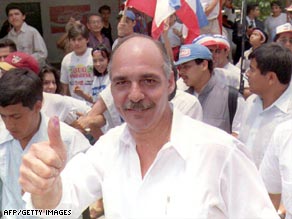
Alfredo Cristiani in 1994 shortly after he voted during the country's second round presidential runoff.

Monday, October 27, 2008

The Gender and Sexuality Workshop

Part of the work that we do at CFO is planning workshops around important issues for youth like human rights, nonviolent communication, self-esteem, leadership, sexuality, etc. Some of these topics interest the youth we work with more than others. Nonviolent communication, for example, seems to be a pretty hard concept for a lot of them to grasp, understandably so as these communities have a very violent history which has shaped the way people live and interact. Sexuality, however, seems to be one of the most popular themes and once the kids get past the initial embarrassment, they REALLY want to talk about it. Which is good, because not many other people are really talking about it with them. According to the kids that I have talked to, public health workers come into the schools about once a year and give a quick overview of basic sexual health. At home, it is often not talked about. But this lack of atention to something that is so much on the minds of teenagers is a big problem in a country where 1/3 of babies are born to teenage mothers and the number of new HIV cases is rising every year.

In talking about sexuality there are a lot of myths and taboos to break down, and not surprisingly, a lot of them relate to women. For that reason, gender workshops for men and for women have become very needed. In one community where we work, Community Raul Rivas Vasquez, all of last year was dedicated to learning about sexuality. This year, in trying to continue some with the theme, we have started a girls group to meet seperately from the guys and to have a space to talk about gender, among other things, in a space that is safe. About a month ago, we did a half day workshop on gender and then went on a field trip in the afternoon to Los Planes de Renderos, a famous scenic lookout about the city. We took twenty-girls as well as three kids who are children of the partipants, two little sisters who were being babysat and couldn't be left alone, a woman from the community who helped us organize the group, her grandson. It was quite an adventure.

The workshop agenda was to briefly touch on sexuality basics and then look at the gender roles in Salvadoran society. It was really interesting to listen to what they thought and ways they all thought alike and the things the disagreed on. The girls have a ton of energy which made the activites fun, though sometimes a little hard to get under control. Overall though, it went really well. Here are some of my observations about the day
1) Almost all of the girls felt that they were trapped in their homes to run the house while their parents worked while their brothers were free to roam the streets and live as they pleased
2) The situation for women in El Salvador, though still very poor, has changed a good deal in the past few decades, so for these girls some of the gender rules do not feel as strong as it does for older Salvadoran women
3) Though all from the same community, a few girls have higher levels of education (they have been able to attend high school or the university, something that is not very common for young people in their community). The ones with higher level of education were more critical of objectification of women.
4) Most of the girls (including the three mothers in the group) did not see men as reliable when it comes to helping support a family

I feel as if I am constantly learning more and more about Salvadoran society through what I see everyday. This workshop was fascinating for me and I really hope that the girls took something from it as well. The field trip to Los Planes was a lot of fun, despite some slight rain and the fact that we had to cram ourselves into a pickup to get there. We took a ton of pictures and you can check them out on my facebook account. Just click on the link below. The second half of the pictures are of a mural that we did in the same community a few days later.

Click to see pictures!!!


Hope you enjoy!

pic of some of the girls from the lookout at El Puerto del Diablo (the Devil's Door), the lookout point in Los Planes de Renderos

Wednesday, October 22, 2008

Food in El Salvador

About two months ago I got inspired by my brother's Argentina blog and decided I was going to write a blog about food in El Salvador. This is me actually getting around to doing that.

So here it goes... food in El Salvador. There are somethings about the food here that I absolutely loved from the start, then there are some things that took me awhile to come around too. There are also those things about Salvadoran food that I really don't like. Seeing as I can't possibly touch on all of it, I will try to hit the highlights.

Comida Tipica
This is the term you to describe typical Salvadoran plates, or the food that Salvadorans most often eat, which would be: rice and beans, Salvadoran tortillas (made from corn, smaller and a lot thicker than Mexican tortillas), sour cream, avocado, Salvadoran cheese (fresco which is softer or duro which is harder, both VERY salty), fried or boiled plantains, scrambled eggs with vegetables and of course COFFEE!!! A few comments: 1) the coffee is served with a ton of sugar and everyone including children drink it, usually its very weak 2) it has taken me a really long time to be able to get used to the sour cream and cheese 3) when the rice and beans are mixed they are called casamiento which means marriage. Everything is seasoned with salt and lime.

Fruit
I've already written a whole blog entry about fruit in El Salvador so I won't elaborate too much, but its definitely one of my favorite things about the food here. Mangoes, oranges, jocotes, mamays, anonas, zapote, mamones, papaya, pineapple, coconut, arrayan, bananas, etc. The can all be bought from street vendors and in markets like the Mercado Zacamil close to my apartment. On street corners and family run cafeterias all of the city you can buy smoothies, called licuados which is any of these fruits mixed with milk, orange juice or carrot juice. It's one of my favorite things for breakfast. Another favorite fruity treat is natural ice cream that is sold mainly by men pushing carts through neighborhoods and parks.

Vegetables
This is mostly the same, but some special veggies found here are pipian-probably one of my favorite vegetables ever which is kind of like zuchinni and squash but sweeter. There is also guisquil, a big watery squash; ayote, another famous squash; and lorocco, which are tiny buds that grow on a vine. People also eat the national flower which is called Flor de Izote.

Pan Dulce (Sweet Bread)
Small bakeries can be found pretty much every couple of blocks in San Salvador though the quality of the bread sold at them differs greatly. For example the bakery closest to my house is not that great while the bakery by the Participacion Juvenil office is one of the best bakery's I've been too. At the bakery you can buy pan dulce which includes donuts, semita, maria luisa, empanadas, etc, etc. All different types of sweet bread that are oftened flavored with icing and filled with creme or pineapple jelly. My favorite and one of the more famous of Salvadoran pan dulce is quesadilla, which is NOT like a Mexican quesadilla. It's like a sweet cornbread that is made with cheese, its delicious.

Pupusas
This is its own category because its the most famous Salvadoran food. For those who don't know, a pupusa is a Salvadoran tortilla, which like I said is thicker and made with ground corn, that is stuffed usually with beans and cheese, porkrind and cheese, lorocco with cheese, cheese alone or my preference, beans alone. It is served with a watery tomato salsa and curtido which is like pickled cabbage and carrott relish. Pupusas are eaten primarily for breakfast or dinner and are EVERYWHERE is El Salvador. There is a pupuseria next too my house which we like to hit up at least once a week.


Maiz (Corn)
I am including this as a category because a large number of Salvadoran typical foods are made from corn. They say that corn was holy to the indigenous that lived around here and that it is understable why when you see how much food can come from it. I already mentioned pupusas and tortillas, but those are not the only things. Tamales are another popular food which is salty, soft, corn dough filled with veggies or chicken and cooked inside a corn stalk leaf rolled up. Tamales are also served sweetened instead of salty and fried. Atol is a thick creamy drink that is made from corn but is sweetened almost like pudding. Shuco is a salty thick drink made from blue corn and served with hot sauce and beans and eaten by dipping bread in it. Corn is also served toasted with lime and salt or as elote loco which is cooked corn on a stick slathered in ketchup, mustard, mayonaise, holaindaise sauce and sprinkled in cheese. I enjoy all of these foods except the last one which I think is disgusting.

Drinks that I have not mentioned
One type of drink I like is fresco which is juice that is usually served at lunch time and made by mixing fresh fruit juice, water, sugar and ice. Flavors include: Flor de Jamaica (made from a flower petal and also served as tea), tamarindo, arrayan, orange and pineapple. Horchata is also served at lunch time, this is sweetened rice milk. As for hot drinks, besides coffee, which is drinken by everyone at anytime regardless of age or temperature, the main other hot drink is chocolate, which is Mexican chocolate melted and mixed with hot water. I really like it a lot, though some people really don't (my friend dropped her camera down an outhouse toilet while trying to covertly dump out the chocolate that was given to her at an event).

Other highlights
Pasteles: veggies or meat cooked into fried dough and served with curtido (see pupusas)
Arroz con leche: hot rice with milk, cinnamon and sugar
Coconut milk: most often drinken by chopping off the top of a coconut and sticking a straw in it
Empanadas: stuffed pastry with veggies or meat
chocofruta: bananas, strawberries, pineapple or grapes on a stick dipped in chocolate
Poleada: vanilla custard
Churros españoles: fried dough covered in sugar and served at fairs (like funnel cake)
Dulces: coconut or tamarindo concentrate sweetened and served at fairs

Things I think don't like about Salvadoran food:
Sopa de pata: which is cow foot soup
Tortas: fried sandwiches with ham and massive amounts of mayo and ketchup
Lack of good salad (salad is lettuce with one tomato and salt on top)
The amount of oil used in everything
The fact that at lunch time EVERYTHING has meat in it
How often hot dogs are cut up and thrown in with pasta, eggs or beans

Those are my highlights and lowlights of Salvadoran food. There are other things that are okay that I have not covered but maybe for the next food blog. I hope anyone reading feels like they learned a little about food in El Salvador!

Friday, October 17, 2008

more than a statistic

El Salvador can be a very dangerous place, so they say. When people give overviews of the country to foreigners, they usually quote some statistic saying its the second most or third most dangerous country in the world with the most homicides per capita in Latin America. When I was a student here I was always so blown away with these facts and in every encounter I had with Salvadorans I would be thinking about how they have been affected by the war or poverty or violence. But since moving here and starting a life in El Salvador, the shock statistics have slipped to the back of my mind and my attention has gone more daily concerns like what to teach in English class, or how out of control the kids in certain groups are or even where I am going to buy the vegetables and cat food. Sometimes when reading the paper or talking to people in the communities, the topic of violence will come up by I find that I am less shocked by these accounts partly because as I did not see it nor know the person, they seem so far away, even if they happened within a five minute walk from my house. But, in a place with a homicide rate as high as El Salvador, it is inevitable that eventually you will know someone who is killed in a very violent manner.

Two weeks ago tonight, on October 3rd, in the community Sierra Alta, two guys from our group in that community were shot and killed while playing cards on the steps in front of the park. At 6:30 at night in this community it was not at all uncommon for young people to hang out on the main corner in front of the little park where all of our group meetings are held. This night it had just started to rain as it so often does at nighttime in October, so most of the kids had headed back to their homes and only two stayed to finish their card game. They were doing exactly that when five young men with guns walked up from around the corner and shot them to death. Maico, his mother's only son, had just turned fifteen and died right there two blocks from his home. Noe, a twenty-one year old with a wife and a three year old son, was rushed to the hospital with nineteen bullets in his body and he died on the operating table. When I visited the following day with my coworkers to visit the stunned, grieving and terrified kids and families of Sierra Alta, there were bullet holes in the wall and blood still on the concrete. On the ground there were a few remaining bloodstained playing cards scattered on the ground.

That night I attended the "vela" along with a number of others from CFO. Traditionally, a vela is held in the homes of the deceased on the night before their burial. Friends and people from the community come to the house to sit with the family and the body all night until the funeral. There is usually coffee, food and praying. This vela was night held in the community due to the fear that the people who killed the boys would take advantage of everyone being in the same place and return. After all, no one knows why it was these specific boys in this specific community on that specific day, they don't know if there was a reason behind the killings or if it was just to instill fear, if it was gang related or not. Some even mentioned that they thought it could be political since these guys were more into the FMLN and soccer than anything else. But, as it was, not many of the young people showed up to the vela anyone due to that fear. The vela, held in a funeral home close to the Center of Mejicanos, was mostly attended by family members and older people. The bodies were laid out in coffins covered with flowers and the jerseys of the guy's newly formed soccer team. Looking into the coffin was a surreal experience as I don't think I have ever seen a dead body before, all the other funerals I have been to have been cremations. I could hardly recognize either of them. It was almost impossible to connect my memories of these two guys joking in meetings, playing soccer and talking about work or girls with the vision of these two lifeless bodies soon to be buried into the earth. impossible.

I didn't know Maico or Noe as well as I know some of the kids in our other groups but I did know them. Maico was quieter but always came to the meetings, he loved to play soccer and my last memory of him is at a soccer tournament they played at about a month ago. He was freaked out to leave to community and his mom was really protective. Noe was really outgoing and was always making jokes, but he was also opinionated and always participated in meetings. He was good a drawing and creative, the other guys looked up to him and it helped in getting them involved in meetings.

When I found out that they were killed I felt nauseous and my head hurt, I cried and couldn't cry. I couldn't stop thinking about their mothers, and family members, or about their friends, the other guys in the community. I couldn't stop thinking about what the last minutes of their life must have been like. I played through all of my memories of Sierra Alta and tried to make sense of the whole thing. As I babbled on to Cesar, half crying, half dazed, I asked him if he knew people who died violently. Of course he did, he grew up in El Salvador. What would it be like to grow up with some one, go to school with them, watch them have kids and then hear that they were stabbed, shot and yes, even decapitated, two blocks from your home? Or to have grown up with kids who became gang members? Or to lose a family member and know that their murderers were still alive and living in your same community? What kind of country is this that people have to get used to hearing about these kind of things. What kind of place is this that the death of these two boys didn't make the press because it is so common? That it most likely will not get investigated by the police. That Maico and Noe will just become another number in the statistics of violent deaths in El Salvador.

Life goes on. Though it will never be the same for those families and for those kids in that community. But it still goes on. For me, this tragedy brings the statistics closer to home. And I now see more clearly how fragil life is. Sierra Alta was a small community on top of a hill overlooking the Salvadoran countryside north of the city. On windy nights, young kids would fly kites. There is a family that sells empanadas, yuca frita and papas cooked over a wood stove. Who knows when it will be that again, right now they are too afraid to leave their homes. But, who knows when life will be snatched from any community in Mejicanos, in El Salvador, anywhere. In El Salvador, you just continue with the violence hanging over your head, never knowing when it will manifest. As I visit communities, and get to know more young people I try to stay conscious of the reality of the injust situations that exist in places like this while at the same time taking in the life and energy that young people can offer. As they would say here: seguimos luchando adelante. we continue to fight on.

Monday, June 9, 2008

Youth in El Salvador

This is an article that another CRISPAZ volunteer, Megan, wrote about youth in San Salvador . Though we don't work at the same site (she works at Fe y Alegria and I work at CFO), we work with some of the same kids. One of the communities that I work in is directly across from the school where Megan works. The description she gives of the neighborhood is exactly what I see when I go into this community every Wednesday night.

Here it is:

Against the Odds: Working with High Risk Youth to Build Peaceful Communities in El Salvador
By Megan Horton, CRISPAZ Volunteer

enteringEsmeralda is a typical 16 year old Salvadoran teenager. She goes to school, has a boyfriend, and loves to listen to reggaeton music. Her living situation is also exceedingly common for Salvadoran youth: Esmeralda and her three siblings live with their aunt and cousins in a small two room concrete and aluminum house in a crowded neighborhood in Zacamil, Mejicanos, an impoverished urban city in the north of San Salvador. Her aunt, Rosa, mends clothes for a living and while she is able to provide for them, supporting a family of eight costs more than sewing brings in.

The community where they live in Zacamil is one of the problematic in San Salvador. Hundreds of houses, just like Esmeralda’s, all grouped together, in a very small area, each with about five to seven people per house. Here narrow alleyways spotted with cockroaches double as a front yards and a garbage disposal for residents. This is not the place for an idyllic childhood. Couple poor living conditions with high population density and problems are bound to emerge. Children are often neglected or used by caretakers as an escape valve; domestic violence is prevalent in these communities.

Esmeralda’s father is an undocumented immigrant in the United States, and her mother left the family behind to make her own living in the north of El Salvador. Many other parents have chosen similar paths, leaving their children with grandmothers, aunts, cousins, or neighbors in search of a better future. Unfortunately, family disintegration is the norm among urban poor in El Salvador. From this break down of the family unit coupled with poverty, lack of opportunities, and domestic violence, a new kind of war has emerged, a gang war.

In El Salvador today, there are two main rival gangs that thrive in poorer areas of the country; the MS-13 and the 18th Street gang. Both began in Los Angeles, increased in number thanks to the marginalization of immigrants and their children, many of whom were refugees from the war. These youths never found the path to a productive life in the US. As young adults many of them were deported back to El Salvador due to their involvement in gangs and crime. Once in El Salvador, a very different country, some youth found familiarity in the gangs, and they proliferated.

From the 1990s through today, gang violence has continued to grow. Today, gangs are just one of the many factors making El Salvador one of the most violent countries in the Americas and in the world. For many young people gangs continue to be attractive. Many youth join due to lack of a family structure (the gang becomes like their family), domestic violence, need for belonging, lack of opportunity, or simply, economic need. Other times they are left no other option.

In Zacamil, the gangs have a huge influence in the daily lives of the communities. The children and youth of these communities, like Esmeralda, are living in the middle of this new war zone. On one side of the street, the MS-13 gang is in control, while across the street, it’s the 18th Street gang that reigns. It is the families who live in these communities who end up suffering the consequences when the two gangs clash. Many of Esmeralda’s childhood friends joined the gangs at a young age, some as young as 7 or 8 years old, and have since been killed.

The Salvadoran government’s response to the gang problem has been repression. They have responded with “iron fist policies”- responding to violence with more violence. There are more and more military patrols. I have seen military tanks rolling down the streets and soldiers outside where I work with high-powered machine guns. The police have begun to arrest young people simply because they think they might be in a gang- “Illicit association”. A youth can be arrested simply for being with “suspicious looking” friends on the street. More and more youth are being associated with gangs, and young, poor Salvadorans are being demonized and dehumanized. This demonization and lack of opportunities has left most young people with two choices- they can either join a gang and become involved in delinquency or leave the country- migrate to the US.

pasajeBecause of the government’s lack of constructive alternatives to the violence, a few non-governmental organizations are now working in the country to try and give youth like Esmeralda a third choice- become constructive members of society and to try to build more peaceful community life. One such NGO is Fe y Alegría (literally, Faith and Happiness), where I have been doing my accompaniment work as a CRISPAZ volunteer here in El Salvador. Fe y Alegría is a popular education and social promotion organization that works throughout the Americas.

Fe y Alegria’s center in Zacamil is a unique one, completely dedicated to providing peaceful and beneficial alternatives for the children and youth in the communities. The Fe y Alegría [Educational Center for All] in Zacamil effectively serves as a before and after-school program. Here, we give the children and youth help with their homework and offer artistic workshops such as dance, painting, and carpentry. But most importantly, we let the kids just be kids; they can run around, jump rope, play tag, and of course, there are always soccer games. Instead of being cooped up in their houses or out on the streets getting into trouble, they have a place to be, a place to learn, and a place to receive positive reinforcement that people do care about them and want them to succeed.

In addition to the Fe y Alegria Center, a number of staff also dedicate time to issues in the streets. I have recently joined this group. We focus on building relationships with the community. We go to the homes of the more troubled kids to listen and talk to their mothers, or, in majority of cases, their guardians. We work toward building trust and understanding in hopes that some healing can take place. More than anything, it is giving an ear to these families and letting them know that people care about their problems. woman

Working with Fe y Alegría in Zacamil has opened my eyes to the troubles of youth in El Salvador. It has given me the opportunity to get to know young people such as Esmeralda, who have gotten a poor lot in life, but are now trying and improve their situation. Fe y Alegría is respected within the communities and seems to have a positive effect on the students. One youth, Eduhuey, has described it as “my second home. But I prefer to be at Fe y Alegría than my actual home.” While the situation of violence and delinquency begs for better policies all around, a better way to deal with crime, youth development, economic policies that allow Salvadorans to make an honest living in their own country and parent their children, Fe y Alegría is taking small steps to make changes in the community. It is helping these youth to break the cycle of violence that has gripped their country . Having youth who refuse to fall into a life of violence sets an example for the rest, and hopefully fewer young people will see gang life and violence as better than their own.

Wednesday, May 21, 2008

La Palma

La Palma, Chalatenango, El Salvador

About five weeks ago, I went up to the town of La Palma in the northern part of El Salvador to do an interview with the artisans in the Semilla de Dios Cooperative. If you have ever bought any wood carvings from 10,000 Villages that comes from El Salvador then it most likely was made at Semilla de Dios. The Cooperative was started in the late seventies by famous Salvadoran artisan Fernando Llort. Llort is credited for creating the style of art that has made La Palma famous. It is characterized by brightly colored paintings of nature, people and homes to represent Salvadoran campesino culture. He began to train people from La Palma in this style of painting. Now, over half the population of La Palma are artisans and travellers often pass through the town to buy the art. A few years ago, the European Union helped finance the painting of walls, houses and phone poles in the La Palma style to promote tourism. The people who don´t create art, run businesses fueled by tourism.

Though there are a number of artisan workshops in La Palma, Semilla de Dios is the most famous one and it has been run for years successfully as a cooperative by all the people who work there. I took a number of pictures of the people at work in the Cooperative. It especially interests me because I have seen these wooden crosses and other painted woodwork sold in Cincinnati, St. Louis and other parts of the Unites States. It was pretty cool to see where all this art was coming from.

Here is the link to see the pictures that I took in La Palma and at la Semilla de Dios:
http://www.facebook.com/album.php?aid=2098096&l=dfd39&id=33307557

Wednesday, May 14, 2008

An article about the environment in El Salvador

This is an article from La Prensa Latina about Deforestation in Central America.

Forests Disappearing in Central America

San Salvador, May 13 (Prensa Latina) The absence of combined Central American policies to protect forests is alarming some governments there.

The vice presidents of Guatemala, El Salvador, and Honduras met in the Montecristo Park, a forest reserve shared by the three countries to boost a joint conservation plan.

In Honduras, for example, in spite of government measures implemented by President Manuel Zelaya, such as the presence of troops in the forests for protection, forest fires and wood trafficking continue.

Such a situation endangers flora and fauna in affected areas, particularly in the north, but also reduces drinking water reserves that supply dozens of communities.

In addition, the soils have been degraded, provoking a reduction of food crops. To date there have been 580 forest fires that have consumed 18,000 hectares of Honduran forests, according to the country's State Forests Administration.

Guatemala has suffered 2,500 forest files that destroyed about 100,000 hectares of forests. Estimates show that 95 percent of those fires were caused by arson.

Illegal felling of trees is another factor that jeopardizes forest diversity, according to institutions such as the Olanch Environment Movement.

El Salvador is considered the nation with most deforestation problems in the Latin American continent. Official studies indicate a 90 percent loss of vegetation and barely two percent of the original forest vegetation.

Open air mining, expansion of agriculture, and use of forest mass for fire and indiscriminate felling are among the lists that is leading this country to desertification.

Now there is a new problem with the destination of huge crop areas to produce biofuels.

Guatemala isn't far behind. Every year it loses 73,148 hectares of forests for different reasons but particularly through human activity.

According to statistics revealed by the environmental profile of that country, 11 percent of natural resources have been lost in the past 10 years, nationwide.

The United Nations Environment Program has repeatedly warned that the region is facing disaster through the increased rhythm of deforestation. It also warned of the need to interrelate conservation, economy and trade to improve the quality of life of their people and the sustainability of natural resources.

The S.O.S. is beginning to be heard. The Monday meeting marks the beginning of joint action of the governments in favor of actions for conservation at least in the region shared by the three that has a population of 750,000 inhabitants in 45 municipalities.

Monday, May 12, 2008

Roque Dalton

Besides being Mothers Day on May 10th, it was also the 33rd anniversay of the death of Salvadoran poet Roque Dalton. I went to a concert in the Centro to commemorate the day and listened to music ranging from Hip Hop to Reggae to Heavy Metal. Not surprisingly, my favorite by far was the Reggae Groups. While sitting there in the park, a street kid came up to us and asked for money to buy food. I bought him a sandwich instead and he sat with us and ate it. A bee started to attack him and he freaked out and started thrashing and ducking from it. A number of people close by started laughing and pointing it made me sad. A few weeks ago I was at a home for street kids who are recovering from drug addictions as most kids who live on the street are addicted to sniffing glue. The kids at this house seemed like normal little boys! I think the kid who ate his sandwich with us had some addictions and he was really dirty and didn´t wear shoes. Its amazing how easy it is to look at a kid differently who is dirty and begging than a kid who is clean and playing soccer with you. When he got up and left he shook our hands and said "Gracias." Ironically, one of the later reggae groups sang a song they had written about street kids and it talked about how easy it is to ignore them and refuse to give them money because you don´t know if it will go to buy drugs.

Relating this back to Roque Dalton...all the groups had pretty cool social messages like this one and it was inspiring to think about how art is used in so many different ways to express beliefs and inspire societies. I will close with my favorite poem by Dalton called "Como tu" or "Like You"

Como Tú (1975)
Por Roque Dalton

Yo como tú
amo el amor,
la vida,
el dulce encanto de las cosas
el paisaje celeste de los días de enero.

También mi sangre bulle
y río por los ojos
que han conocido el brote de las lágrimas.
Creo que el mundo es bello,
que la poesía es como el pan,
de todos.

Y que mis venas no terminan en mí,
sino en la sangre unánime
de los que luchan por la vida,
el amor,
las cosas,
el paisaje y el pan,
la poesía de todos.


Like You
By Roque Dalton
(Translated by Jack Hirschman)

Like you I
love love, life, the sweet smell
of things, the sky-
blue landscape of January days.

And my blood boils up
and I laugh through eyes
that have known the buds of tears.
I believe the world is beautiful
and that poetry, like bread, is for everyone.

And that my veins don’t end in me
but in the unanimous blood
of those who struggle for life,
love,
little things,
landscape and bread,
the poetry of everyone.

Tuesday, April 15, 2008

Life on the Salvadoran Bus

I take bus to get most places in El Salvador. Sometimes I am lucky to get a ride from someone with a car or in the CRISPAZ or CFO truck. But mostly, I bus it, or I walk. I feel like you are faced with a lot of reality of the bus in El Salvador.

To give some background, there are two main types of busses. Big busses and little busses (microbusses). The big ones are mostly used school busses like I remember from grade school. The micros can be anything from smaller versions of the big bus or big vans. The micros are crazier and go faster. There is usually a driver and a person who jumps off at everystop and yells "CENTRO, CENTRO, SUBA SUBA, UNA CORDA, UNA CORDA" (Downtown, Downtown, get on, get on, a quarter, a quarter). The drivers tend to race each other and chase down customers, especially if they are the same number. Most are decorated with stickers or paint about God and Jesus or with women´s names. There are usually safety warnings and rules written in English. Sometimes there are bullet holes in the windows and they are usually dirty. Music on the busses can range from Ranchero to Reggaeton to American 80´s music. Sometimes they are so crowded that everyone is standing and some people are almost hanging out the door. Sometimes they are almost empty.

Bus passengers can be anyone. Men and women in business suits, mothers with small children, elderly people, students, mothers, fathers, children. Pretty much anyone who can´t afford to have a car, which is most people. Usually strangers don´t talk to each other. But it is not uncommon for a stranger to offer to hold your bag if there is no seating and you are standing and they are sitting next to you. Nor is it strange for strangers to give a hand to people who trip or drop something. Passengers can be anyone who pays the 25 cents.

Then there are the vendors. The people who make a living by selling things on the bus. They climb on the bus and the drivers never charge them. There are the common men, women and children yelling "CHICLE, CHICLE, CARAMELOS, CAREMELOS, AGUA, AGUA, PUPUUUUUSAS, PUPUUUUUSAS, MANGOS, MANGOS, CAPUCHINO, CAPUCHINOS" (Gum, Gum, Candy, Candy, Water, Water, Pupusas, Pupusas, Mango, Mango, Ice cream cone, ice cream cone). Then there are the newspaper vendors who stand up front and read sections of the paper in a loud voice to get people interested. Or the the people who pass out Mickey Mouse sticker, ballpoint pens and religious postcards and then stand in front of you and give you a big sales pitch before recollecting what they past out in hopes that some people will want to keep these treasures now that they have held them in their hands. Or the people who stand up in front and try to sell you a natural medicine that cures everything from obesity to cancer. These people can be anyone from small children, young women, old women, old men, young men, anyone, anyone. And people always buy from them. Even the guys selling the cancer medicine. Who knows if its to support the 8 year old kid trying to sell gum or if they really wanted that special pen. Both I think. I know I have bought from the vendors for both reasons.

They other category of people I will call the performers. This category includes my favorite people to see on the bus and some of my least favorite people. The least favorite is the people who stand up front and start to scream loudly about what will happen to all of us if we don´t accept God. Sometimes this includes a personal account. Sometimes the person is also selling cards with God phrases. They will stand up, yell for twenty minutes about sin, then sit down and wait quietly for the bus stop. Most people don´t even really seem to notice them. My favorite category is the musicians. Like the guys who play the guitar and the Andean music. I ALWAYS give them money because I enjoy it so much that I feel like I would be stealing if I didn´t. The other day I heard by far the best street performers I have seen here, two young guys playing guitar and singing Led Zepellin.

The last category is the beggars. Like the vendors and the performers, they are allowed on the bus without paying. Usually it is obvious they are homeless or living in very poor conditions. Sometimes they are disabled, or missing limbs. Sometimes they are children or parents with children. Sometimes they give a testimony about what has happened to them. The children don´t usually give a talk. A lot of them are addicted to sniffing glue, a habit common among the homeless here as it dulls pain and hunger. The really moving thing is how many people give money. I guess in a country where so many people struggle to get buy, its harder to place blame on the beggars and the homeless, its easier to see oneself in their shoes.

Salvadoran busses can be dangerous. I know so many people who have been robbed or pickpocketed on busses. Sometimes silently, sometimes violently. I have heard horror stories about acts of violence happening on busses that I sometimes take. I try to avoid taking the bus at night with this in mind. Or at least taking the bus alone at night.

Why am I writing all of this? Because I feel like I am constantly confronted with the Salvadoran reality on busses. Whether its the drivers, the passengers, the vendors, the performers or the beggars. Sometimes I imagine where these people will go when they get off the bus. Will the candy vendors make enough money to buy dinner for their family? Especially with the rising price of basic foods like beans or flour? How does the man preaching God feed himself? Where will that child sleep tonight? Sometimes I say a quiet prayer as these people step off the bus I´m on and onto a new one, a prayer that what they earn will be enough. Or I wonder about the bus driver. Have the gangs threatened him? What has he seen? Where does he live? I wonder, I wonder.

I read in the paper on Sunday that the bus fare was going up from 25 cents a ride to 30 cents to to a hike in gasoline prices. I can only imagine what that will bring...

Monday, April 7, 2008

The Veracruz Breakers

I've realized I haven't written to much about the actual youth that I am working with, besides the intro to CFO that I gave in the middle of February. So I'm going to write a little bit about one of the groups that CFO works with that calls themselves "The Veracruz Breakers." As in the break dancing boys from Veracruz (a neighborhood in Mejicanos).

The guys started working with CFO last year when the Parish began to allow them to use one of the community center spaces to practice breakdancing three times a week. On Thursdays they meet in CFO with Ada, Marcos and I to do workshops around themes like leadership, human rights or self-identity. They practice break on Monday, Wednesday and Friday from 2-5 and they are GOOD. That is probably what happens from practicing as often as they do, added to the fact that they are very dedicated to the Hip Hop Movement. Today I went to see them dance as I had never been to the actual community where they live (the Parish itself is further down the hill closer to the Center of Mejicanos). At one point I asked Maicol (prounounced like Michael) where they got their songs. He told me that they get all their stuff off the internet at ciber cafe's. That's also how they learned all their moves, by looking it up on YouTube. What a crazy globalized world we live in where Salvadoran boys are using the internet to teach themselves to breakdance and to learn about hip hop culture. Maybe someday they will put their own video on YouTube and you can all see how good they are. Last year through CFO and a music group they know, they were able to produce a song about their lives in El Salvador. It's also very impressive.

Now I know a lot of people who relate Hip Hop to crime and delinquency, which is too bad since there is a lot of culture and history in the whole movement. Here in El Salvador, breakdancing and hip hop music has actually helped to keep these guys out of violence. You see, Veracruz or more specifically the colonia Montreal, where they live, has a lot of gang problems. There is a lot of violence and there is also a lot of police oppression directed towards young Salvadoran men. Especially anyone with a tattoo, or anyone who dresses a certain way. Most of these guys have had run ins with the police or with gangs. Almost all of them could't afford to go to high school. Almost all of them are unable to find work. A lot of them were raised by single mothers and have family in the United States. Today after I had English class with one of the guys, Saul, he told me about how the Earthquake in 2001 devastated this community, destroying homes and killing people. Many of them were not able to rebuild their homes for a few years as they recieved no governmental assistance.

Despite all of this, the guys are pretty normal teenage guys. Most of them are the age of my little sister (18), give or take a few years. So its very different from working with some of our other groups who are younger and have more girls. Sometimes its harder to get to know them because of this and I feel frustrated that culture, language and gender can be such barriers. But today was a good day. Seeing the neighborhood where they lived helped me understand a little more where they come from. Most of my time with them is spent at CFO where they all congregate on Thursdays and often drop by other times during the week. Right now, four of them are waiting to hear back from a scholarship that we helped them apply for to do a research project on youth in El Salvador. We'll see how it goes, though I think their application was pretty impressive. Maybe I'm biased though.

Anyway, thats a closer work at who I'm working with. Someday maybe I'll try to figure out YouTube and how to put a video of them on it. Until then, I hope my description was enough.

peace and love, -Laura

Monday, March 31, 2008

Romero quotes


Oscar Romero (1917-1980)


We must not seek the child Jesus in the pretty figures of ourChristmas ribs. We must seek him among the undernourishedchildren who have gone to bed tonight with nothing to eat, amongthe poor newsboys who will sleep covered with newspapers indoorways. December 24, 1979


When we say "for the poor," we do not take sides with one socialclass, please note. What we do, according to Puebla, is inviteall social classes, rich and poor without distinction, saying toeveryone: Let us take seriously the cause of the poor as thoughit were our own -- indeed, as what it really is, the cause ofJesus Christ, who on the final judgment day will call tosalvation those who treated the poor with faith in him. "Whateveryou did to one of these poor ones -- the neglected, blind, lame,deaf, mute -- you did to me." September 9, 1979


Everyone who struggles for justice, everyone who makes justclaims in unjust surroundings, is working for God's reign, eventhough not a Christian. The church does not comprise all of God'sreign, God's reign goes beyond the church's boundaries. Thechurch values everything that is in tune with its struggle to setup God's reign. A church that tries only to keep itself pure anduncontaminated would not be a church of God's service to people.The authentic church is one that does not mind conversing withprostitutes and publicans and sinners, as Christ did -- and withMarxists and those of various political movements -- in order tobring them salvation's true message. December 2, 1978


What good are beautiful highways and airports, beautifulbuildings full of spacious apartments, if they are only puttogether with the blood of the poor, who are not going to enjoythem? July 15, 1979


The church in Latin America has much to say about humanity. Itlooks at the sad picture portrayed by the Puebla conference:faces of landless peasants, mistreated and killed by the forcesof power, faces of laborers arbitrarily dismissed and without aliving wage for their families, faces of the elderly, faces ofoutcasts, faces of slum dwellers, faces of poor children who frominfancy begin to feel the cruel sting of social injustice. Forthem, it seems, there is no future -- no school, no high school,no university. By what right have we cataloged persons asfirst-class persons or second-class persons? In the theology ofhuman nature there is only one class: children of God. March 2,1980


Many would like the poor to keep on saying that it is God's willfor them to live that way. But it is not God's will for some tohave everything and others to have nothing. That cannot be ofGod. God's will is that all his children be happy. September 10,1978


The great need today is for Christians who are active andcritical, who don't accept situations without analyzing theminwardly and deeply. We no longer want masses of people likethose who have been trifled with for so long. We want personslike fruitful fig trees, who can say yes to justice and no toinjustice and can make use of the precious gift of life,regardless of the circumstances. March 9, 1980


Peace is not the product of terror or fear. Peace is not thesilence of cemeteries. Peace is not the silent result of violentrepression. Peace is the generous, tranquil contribution of allto the good of all. Peace is dynamism. Peace is generosity. It isright and it is duty. In it each one has a place in thisbeautiful family, which the Epiphany brightens for us with God'slight. January 7, 1978


God in Christ dwells near at hand to us. Christ has given us aguideline: "I was hungry and you gave me to eat." Where someoneis hungry, there is Christ near at hand. "I was thirsty and yougave me to drink." When someone comes to your house to ask forwater, it is Christ, if you look with faith.In the sick person longing for a visit Christ tells you, "I wassick and you came to visit me." Or in prison.How many today are ashamed to testify for the innocent! Whatterror has been sown among our people that friends betray friendswhom they see in trouble! If we could see that Christ is theneedy one, the torture victim, the prisoner, the murder victim,and in each human figure so shamefully thrown by our roadsidescould see Christ himself cast aside, we would pick him up like amedal of gold to be kissed lovingly. We would never be ashamedof him.How far people are today -- especially those who torture andkill and value their investments more than human beings -- fromrealizing that all the earth's millions are good for nothing, areworthless, compared to a human being. The person is Christ, andin the person viewed and treated with faith we look on Christ theLord. March 16, 1980


Quotes taken from http://www.justpeace.org/romero.htm

Remembering

I realize that I have not updated my blog in the past month and I apologize for that. The month of March has been eventful. I think partly I have been putting off writing because there is so much I have wanted to write about such as: visiting artisans workshops in Chalatenango, a trip to a small remote town called Amatitan to celebrate International Women's Day, Holy Week, my work at CFO and the anniversary of Romero's death. On top of that, I have recently moved into an apartment which I have been working on setting up and organizing with my two roommates. I'll try to hit some of the highlights of all of these with my theme being REMEMBERING.

Women Remembering Women
I have never heard of International Women's Day until I came to El Salvador, which is too bad for the women of the United States since the day is March 8 to commemorate the deaths of women factory workers who died in New York City about 100 years ago. Here, all over the country there were a number of celebrations going on. I had planned on going to the big march downtown with some of the women from CFO. Though a few days before I was invited to celebrate women's day in the tiny remote town of Amatitan in the department San Vincente. Cesar and his two classmates are working on a community organizing project there through. The event was supposed to start at 6:00 pm. As it was on El Salvador time, we (who were running the event) showed up at 6:15 to set up. An hour later people started showing up. Pretty soon there were about 60 or seventy people, mostly women. It was a cool night and what struck me was that they were all using towels as shawls. The ingenuity of people here often impresses me, in a place like San Vincente which is fairly hot, one wouldnt normally invest in a jacket, but towels are quite common. Anyway, I digress. The event started out with a short clip about the war and then songs about Salvadoran women and El Salvador. Then came the time to talk about and remember important women from their community who had died, many during the war. This went on for a while. Soon a few women showed up with sweet bread and coffee to distribute. Erick, my friend who was helping organize, pointed out that since it was women's day then maybe the men could serve the drinks and bread. This was a hoot since it completely challenged established gender roles. However about 5 men wanting to prove their support for women jumped up and started passing out the food. The highlight of the evening was when at the very end, the Women's Association of Amititan acted out the fight for rights and then the deaths of the women who had died in New York City so long ago. The oldest actress was probably in her sixties and the youngest looked to be about 8 and she reminded me so much of my cousin Sarah. It was quite an exprerience and it helped make up for the fact that until last year (also in El Salvador) I had never celebrated International Women's Day.

Remembering Home
Sometimes I get homesick. Everyone says this is normal for people living abroad but still I didn't really expect it. It hits me at various times: the grocery store when I can't find any food I like or listening to music that reminds me off my friends back at home. Easter was harder than I thought it would be. I had a wonderful week of vacations visiting the Bajo Lempa, the beach and Cesar's town Tepecoyo. But around the middle of the week when we went to the beach, I started to think about my Grandma and Grandpa Hersh and Palm Island. This is probably because I was on an island. Then on Good Friday while making alfrombras, or salt murals, on the streets of Tepecoyo for the Way of the Cross, I thought about the Way of the Cross in Cincinnati with all the Social Justice Groups. Later as I tried to explain the Easter Bunny and was given the look of "you gringos are absurd" I realized I would not be eating any chocolate eggs this year. When I was woken up Easter morning by the 6am procession and singing, I wondered if back at home my mom was blasting the Sandy Patty version of "Was it a morning like this." Experiencing Holy Week in El Salvador was really great, but I was surprised by how much I missed being at home.
Sometimes people remind me of people at home. I already mentioned the girl who reminded me of my cousin. There is a another boy in one of the groups at CFO who reminds me so much of my other cousin Stephen. And a girl in the Bajo Lempa who reminds me of one of the girls who I knew from the Center for Survivors in Saint Louis. She is ten and she has a cousin who is the same age as her, together, they remind me of my cousin Kristin and I. This type of remembering doesn't make me sad though. Mostly it makes me smile.
I mentioned that I visited Chalatenango a few weeks ago. It was a wonderful visit. I was able to meet the artisan groups for Las Flores and La Ceiba. It was inspiring to see them doing their work. While in Chalatenango we also stopped briefly in the town of Guarjila to plan the delegation visit to the Jon Cortina museum. Jon Cortina was an amazing Jesuit priest who dedicated his life to walking alongside the Salvadoran people. He helped with the rebuilding of Guarjila when the refugees came after the war. Before his death in 2005, he visited SLU and recieved a sword from the Jesuits to commemorate his life working for peace (kind of ironic). I remember shaking his hand. The sword is in the museum (his former house) along with other remnants of his life in El Salvador. One picture especially got me. It was of Jon Cortina with a Loretto Sister from Saint Louis named Ann Manganaro. She was nurse who lived in the community during the war. In 1994 she died of cancer and now the clinic is named after her. She is known among social justice groups in Saint Louis as well as in Guarjila. Saint Louis has a long lasting relationship with the town of Guarjila and looking through all the photos of the rebuilding of Guarjila, I couldn't help but think about all the people back in Saint Louis who I know who care so passionately about this place.

Remembering Romero
Archbishop Oscar Romero is probably one of the most renowned Salvadorans of all time. If you don't know who is is then I encourage you to read more about him because I won't be able to describe completely who he was. But in simple words: he was the Archbishop of El Salvador during a time of horrible violence and oppression and he was completely dedicated to walking with the people of El Salvador. As an archbishop he had power and he used it to defend the rights of people who were suffering under horrible oppression. He appealed to Jimmy Carter to stop funding the oppressive government, with no avial. Nor did the Vatican pay much attention to his pleas. In March of 1980, he gave a powerful homily asking Salvadoran soldiers to please put down their guns and stop killing their fellow Salvadoran brothers. The next day, he was shot and killed during mass.
28 years later he is still loved and revered. The people call him San Romero de las Americas. Saint Romero of the Americas, even though he has yet to been made a saint. His face and his words are painted all over poor communities all throughout El Salvador. The alfombra (salt mural on the street) that I helped make during Holy Week was a picture of him reaching out to a fallen campesino (Salvadoran peasant). Signs and shirts read: Romero vive! In a country that is as religious and impoverished as this one, an archbishop who talks about a God of love for the poor and a God of justice is up there with Jesus.
This past Saturday was the march and vigil to commemorate the life and death of Romero. The streets were closed off and we marched from the Salvador del Mundo statue to the Cathedral where Romero was buried. It was inspiring to see so many young people like myself who were born after the death of Romero but still so inspired by his life. There was then a giant mass in front of the Cathedral. The people camped out in the square all night listening to music and eating pupusas. It amazing to see how in death, Romero continued to live. He has a quote that says "If they kill me, I will rise again in the Salvadoran people." And he has.